

Dhanteras falls on Friday, 6 November 2026, and the same ₹1,00,000 buys very different amounts of gold depending on the route. Buy jewellery with a 10% making charge and the gold price must rise 13.5% before you recover your cost. Buy a gold ETF and the break-even is closer to 1%.
This guide compares physical gold, digital gold and gold ETFs on the three things that decide a Dhanteras investment: what you pay upfront, what purity you get, and how the sale is taxed. The examples use stated assumptions. Replace them with your jeweller’s quote and your fund’s expense ratio.

What each route costs on ₹1,00,000
Of ₹1,00,000 spent on gold jewellery with a 10% making charge, about ₹11,894 goes to making charges and GST rather than gold. A coin, bar or digital gold purchase loses ₹2,913 to 3% GST. A gold ETF carries no GST; its main cost is an annual expense ratio.
| Route | Upfront overhead | Gold price rise to break even |
| Gold jewellery (10% making charge) | ₹11,894 | 13.5% |
| Gold coin or bar (no making charge) | ₹2,913 | 3.0% |
| Digital gold | ₹2,913 | 3.0% |
| Gold ETF (two-year hold) | About ₹1,045 | About 1.0% |
The assumptions behind the table:
- GST is 3% on gold and 5% on making charges.
- The making charge is an illustration, since jewellers set their own.
- The ETF row assumes a 0.50% annual expense ratio and ₹20 brokerage per order.
- Bid-ask spreads, platform spreads, and exchange and demat charges are not included.
Making charges are paid at purchase and typically do not come back on resale. That is why the jewellery break-even is so high. If you are buying to wear or gift, that cost pays for craftsmanship, not investment return.
Purity: what you are actually holding
Gold ETFs hold gold of 99.5% purity. Hallmarked jewellery carries a BIS mark with a six-character HUID, and 22K jewellery reads 916. Digital gold purity depends on the platform, because SEBI does not oversee it, so read the provider’s vaulting and audit terms before buying.
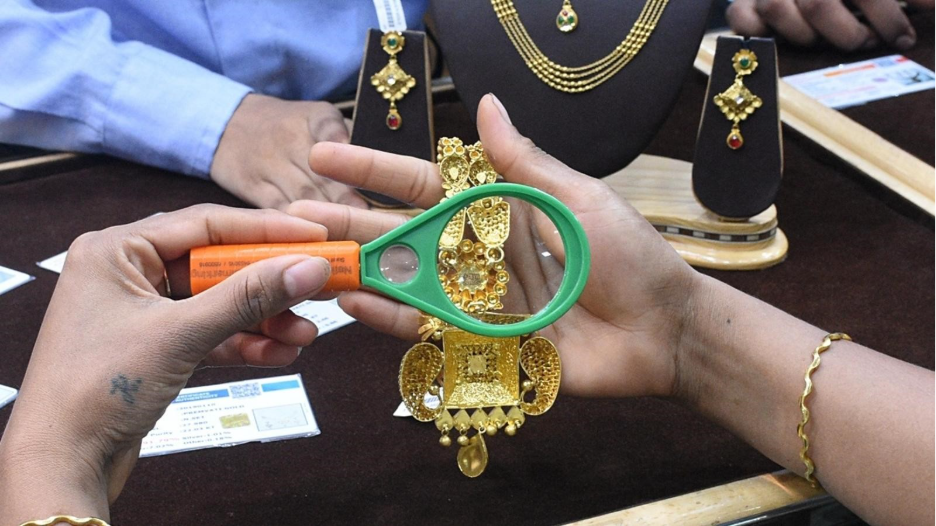
For jewellery, check the BIS logo, the purity mark and the HUID on the piece. Then enter the HUID in the BIS Care app under “Verify HUID” before you pay. Coins and bars in 24K follow a separate hallmarking scheme, so ask the seller which mark and certificate come with the piece.
With a gold ETF, there is nothing to inspect. SEBI requires the fund to hold gold at 99.5% purity, and the units sit in your demat account.
Gold ETF taxation: why the 12-month line matters
Listed gold ETFs qualify for long-term capital gains tax after 12 months, at 12.5% without indexation. Physical gold, jewellery and digital gold need more than 24 months for the same 12.5% rate. Shorter holds are taxed at your income slab rate. Confirm with a chartered accountant.
The table assumes a ₹20,000 gain and a 30% slab. It excludes surcharge and the 4% cess.
| Holding period | Gold ETF tax | Physical or digital gold tax |
| 8 months | ₹6,000 | ₹6,000 |
| 13 months | ₹2,500 | ₹6,000 |
| 25 months | ₹2,500 | ₹2,500 |
The gap opens at 13 months: ₹2,500 on the ETF against ₹6,000 on physical or digital gold. After 24 months the rates match. Where the gold route differs most is not the rate but the waiting period.
Digital gold vs gold ETF
Digital gold attracts 3% GST on purchase and sits outside SEBI’s regulation, while a gold ETF has no GST and is SEBI-regulated. SEBI cautioned investors about digital gold in November 2025, citing counterparty and operational risks. The tax holding period also differs: 24 months for digital gold, 12 months for a listed gold ETF.
| Feature | Physical gold | Digital gold | Gold ETF |
| GST on purchase | 3%, plus 5% on making charges | 3% | None |
| Oversight | BIS hallmarking for jewellery | Outside SEBI’s framework | SEBI-regulated |
| Purity | Hallmark, such as 22K916 | Stated by the provider | 99.5% |
| Long-term gains after | 24 months | 24 months | 12 months |
SEBI’s notice was a caution, not a ban. Digital gold remains legal, and the risk sits with the platform you choose.
How to buy a gold ETF before Dhanteras
Dhanteras falls on a Friday, and NSE is open that day, so orders can be placed during regular market hours. The exchange is closed on Tuesday, 10 November for Diwali Balipratipada.

- Confirm you have an active demat and trading account. If you need help getting started, read how to open a demat account. A gold ETF trades like a share, and the units arrive in your demat account.
- Compare funds on expense ratio, tracking error and trading volume. Lower tracking error means the unit price follows the gold price more closely.
- Search for the fund in your trading app and compare its traded price with its NAV before ordering.
- Place a limit order at the price you accept. This matters most for funds that trade thinly.
- Check your holdings after settlement and note the purchase date, which starts the 12-month clock.
When physical gold still makes sense
Physical gold does things an ETF cannot. You can wear it, gift it, and hold it as part of a family ritual. Some households may want a small coin on Dhanteras itself, with the larger allocation in an ETF. Whether a demat holding satisfies the tradition is a family decision.
A gold ETF has its own limits. It needs a demat account, it trades only during market hours, and its tracking error means the unit price can drift slightly from the gold price. For more details on how gold ETFs work and what to compare before investing, read this gold ETF investing guide. Sovereign Gold Bonds and gold mutual funds are not covered here.
Before Dhanteras, ask your jeweller for a written quote that separates gold value, making charge and GST. Divide the total by the gold value and you have your break-even, the same figure used in the first table.
*This article is educational and is not investment or tax advice.
FAQs
Is a gold ETF cheaper than physical gold?
Usually, on upfront cost. A gold ETF has no GST or making charges, and its main cost is an annual expense ratio. Jewellery adds GST and making charges, which can total over 10% of the purchase price in the example above.
How is a gold ETF taxed in India?
Gains on a listed gold ETF held for more than 12 months are taxed at 12.5% without indexation. Gains on units sold within 12 months are added to your income and taxed at your slab rate.
Is digital gold safe compared with a gold ETF?
SEBI regulates gold ETFs but not digital gold. In November 2025, SEBI warned that digital gold carries counterparty and operational risks and sits outside its investor protection framework. A gold ETF also avoids the 3% GST that digital gold carries.
More Stories
2025 Economic Outlook: Navigating the Crystal Ball of Finance
Navigating Tomorrow: Bold Economic Forecasts That Will Shape Your Next Decade
The Future Unfolded: Navigating the Economic Horizon